Food cost percentage is the first number most restaurant owners learn, and one of the easiest to get wrong. Worked out properly, it tells you whether your menu prices still match what you pay for ingredients. Worked out loosely, it hides the dishes that are quietly losing money.
This guide covers the two ways to calculate it (for the whole restaurant and for one dish), what a sensible target looks like, and the mistakes that throw the number off.
The formula for the whole restaurant
For a week or a month, food cost percentage is what the food you used cost you, divided by what you sold.
Food cost % = (opening inventory + purchases − closing inventory) ÷ food sales × 100
The part in brackets is your cost of goods sold. Counting stock at the start and end of the period matters: if you only add up purchases, a big order on the last day of the month makes your food cost look terrible, and skipping an order makes it look great. Neither is true.
| An example month | Amount |
|---|---|
| Opening inventory (food) | $8,200 |
| + Food purchases | $27,400 |
| − Closing inventory (food) | $7,600 |
| = Cost of food used | $28,000 |
| Food sales (before tax and tips) | $92,000 |
| Food cost % | 30.4% |
Keep food and drink separate if you sell alcohol. Drinks usually run at a very different cost percentage, and mixing them hides what’s happening on each side.
The formula for one dish
The restaurant-wide number tells you whether there’s a problem. The per-dish number tells you where. For one dish:
Dish food cost % = cost of the ingredients on the plate ÷ menu price (before tax) × 100
To get the plate cost, list every ingredient with the amount used, and price each one from what you actually pay. Two details make the difference between a rough guess and a number you can trust:
- Yield. A case of romaine isn’t all usable. If you trim 20% away, the lettuce on the plate costs 25% more per gram than the invoice suggests. The same goes for meat trimmed and cooked down, fish filleted and herbs picked.
- Prep items. Sauces, dressings and doughs have their own recipes. Cost them once as a prep item, then use them in dishes like any other ingredient.
| Smash burger | Amount | Cost |
|---|---|---|
| Brioche bun | 1 of a 12-pack at $6.24 | $0.52 |
| Ground chuck | 180 g at $15.40/kg | $2.77 |
| Cheddar | 2 slices | $0.46 |
| House sauce (prep item) | 30 ml | $0.26 |
| Onion | 34 g used, 85% yield | $0.06 |
| Pickles, lettuce | 45 g | $0.37 |
| Butter, seasoning | $0.18 | |
| Plate cost | $4.62 | |
| Menu price | $14.50 | |
| Food cost % | 31.9% |
What’s a good food cost percentage?
Many restaurants land somewhere between 28% and 35% across the menu, but the right target depends on what you sell and how. A pizzeria or café can often run lower; a steakhouse or seafood restaurant usually runs higher and makes it up in dollars per plate. What matters more than any industry figure is:
- Your own target, set so that food plus labour (your prime cost) leaves room for rent and profit.
- The trend. A food cost that creeps from 30% to 33% over three months is a problem even if 33% sounds normal.
- Dollars, not just percentages. A dish at 38% that earns $15 a plate can be worth more to you than one at 25% that earns $4.
Five mistakes that throw the number off
- Old prices. Costing a menu once and never updating it. Supplier prices move every week; your plate costs should too.
- Ignoring yield. Pricing from the invoice weight instead of the usable weight.
- Forgetting the small stuff. Oil, butter, garnish, sauces, takeout packaging. Each is small; together they can be a couple of points.
- Purchases instead of usage. Without stock counts, the monthly number jumps around for reasons that have nothing to do with the kitchen.
- Theoretical versus actual. The recipe says 170 g of beef; the line might be using 190 g. Comparing what should have been used (from sales and recipes) with what was used (from counts) shows the gap.
How Skillet does this for you
Everything above can be done in a spreadsheet. The trouble is keeping it current: every new invoice changes a dozen plate costs. Skillet keeps the numbers live so you can see them whenever you look. Costing is part of Skillet Insights (which works alongside the POS you already have) and Skillet Complete.
- Ingredients as you buy them. Enter each ingredient with its supplier, pack size and yield. Skillet keeps every price change, so you can see when something went up.
- Supplier invoices in a few taps. Upload an invoice, check the lines and confirm. Skillet remembers each supplier’s wording, so the next one is quicker.
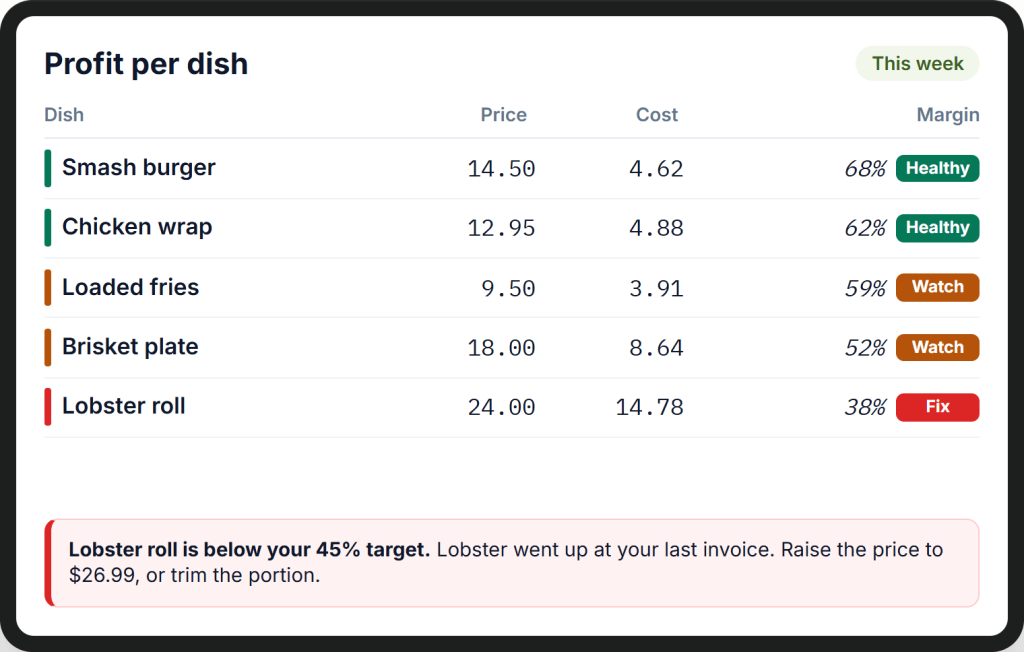
- Every dish costed automatically. Recipes and prep items are costed from your latest prices, with yield included. When a price changes, every dish that uses it updates.
- Margin alerts with the fix. When a dish slips below your target, or a supplier price jumps 5% or more, Skillet tells you which dish, why, and suggests a new price or portion.
- Stock counts that show the gap. Counts and a waste log give you weekly cost of goods, and the difference between what should have been used and what was.
Want to see it with your own menu? Start a 30-day free trial and load the sample menu, or import your dishes and ingredients from a spreadsheet. No card needed.