
Most menu prices start with a look at what the place down the street charges. That’s a fair check, but it’s a poor starting point: their rent, suppliers and portions aren’t yours. A better way is to start from what the dish costs you to make, then decide what it needs to earn.
Step 1: cost the plate
List every ingredient in one portion, and work out what that amount costs from your actual pack prices. Here’s a smash burger:
| Ingredient | How it’s costed | Cost |
|---|---|---|
| Brioche bun | 1 of a 12-pack at $6.24 | $0.52 |
| Ground chuck | 180 g at $15.40/kg | $2.77 |
| Cheddar slices | 2 slices | $0.46 |
| House sauce | 30 ml, costed from its own recipe | $0.26 |
| Onion | 34 g used, 85% yield | $0.06 |
| Pickles, lettuce | 45 g | $0.37 |
| Butter, seasoning | $0.18 | |
| Cost to make | $4.62 |
Two things people miss:
- Yield. If you trim 15% of an onion, you pay for 100% and use 85%. Divide the cost by the yield (0.85) to get the real cost per usable gram.
- Prep items. Sauces, doughs and dressings have their own recipes. Cost them once, then use them as an ingredient in every dish that needs them.
Step 2: choose a target food cost
Your target food cost percentage is the share of the menu price you’re willing to spend on ingredients. It depends on the dish and on the rest of your costs, so it’s normal to have different targets for mains, sides and drinks. For this example, we’ll use 32%.
Step 3: work out the price
Menu price = cost to make ÷ target food cost
$4.62 ÷ 0.32 = $14.44. Round to a price that suits your menu, such as $14.50, and the burger’s food cost is 31.9%, with $9.88 left over from each plate before labour and everything else.

Step 4: sense-check it
- Look at dollars, not just percentages. A steak at 40% food cost can still leave more money per plate than fries at 20%. Both numbers matter.
- Compare with your market. If your price is far above similar dishes nearby, look at the portion or the recipe before raising the price.
- Add packaging for takeout. Boxes, bags and cutlery come out of the same plate.
- Price delivery separately. App commissions change the maths. We cover that in how to price for delivery apps.
Step 5: keep it current
A price that was right in spring can be wrong by fall. When a supplier price moves, every dish that uses that ingredient moves with it. Re-cost your best sellers whenever an important price changes, and review the whole menu a few times a year.
Try it with your own dish in our free food cost calculator: enter pack prices, amounts and yield, and it shows the food cost and the price for your target.
How Skillet does this for you
Costing one dish on paper takes ten minutes. Keeping a whole menu right, week after week, is the hard part. Skillet does it for every dish at once (on Skillet Insights and Skillet Complete).
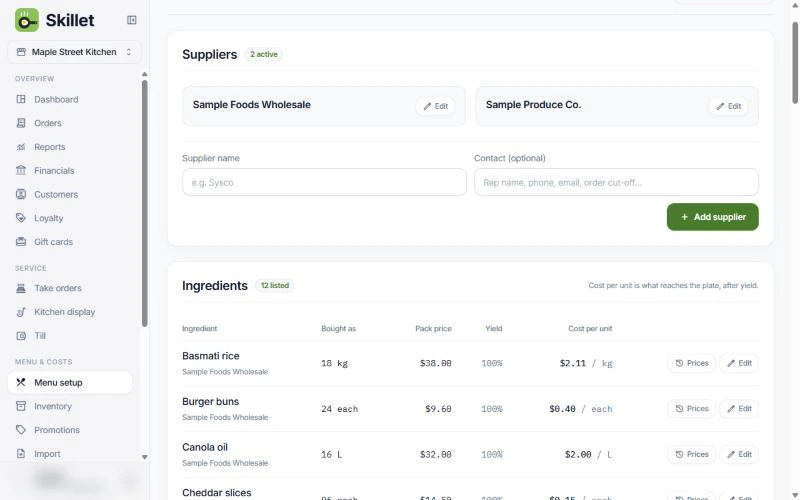
- Ingredients as you buy them. Pack sizes, prices and yield for every ingredient, with every price change kept.
- Recipes and prep items. Build each dish from ingredients and prep items like house sauce. Recipe versions keep past reports true when you change a recipe.
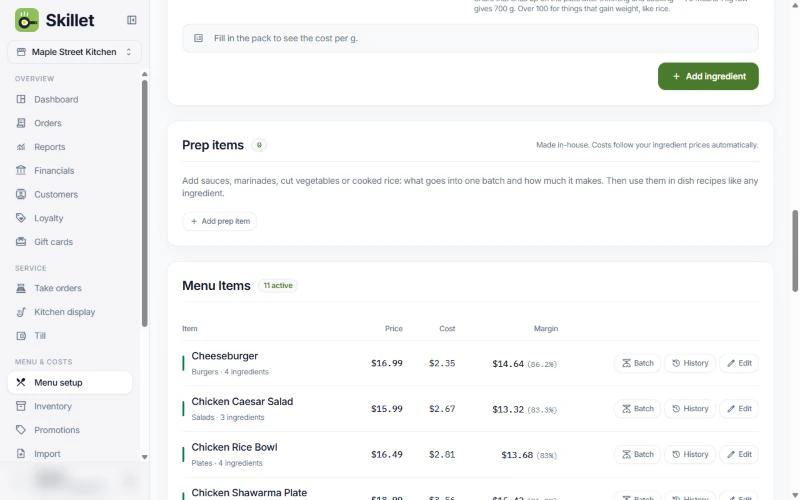
- Cost, price and margin side by side for every dish, colour-coded against your target.
- Alerts with the fix. When a supplier price jumps 5% or more, or a dish slips below your target, Skillet tells you which dish and why, and suggests the new price or portion.
- Start from what you have. Import your menu, ingredients and recipes from a POS export or spreadsheet, or start from the sample menu to see how it works.
Start a 30-day free trial and see your own menu costed. No card needed.